
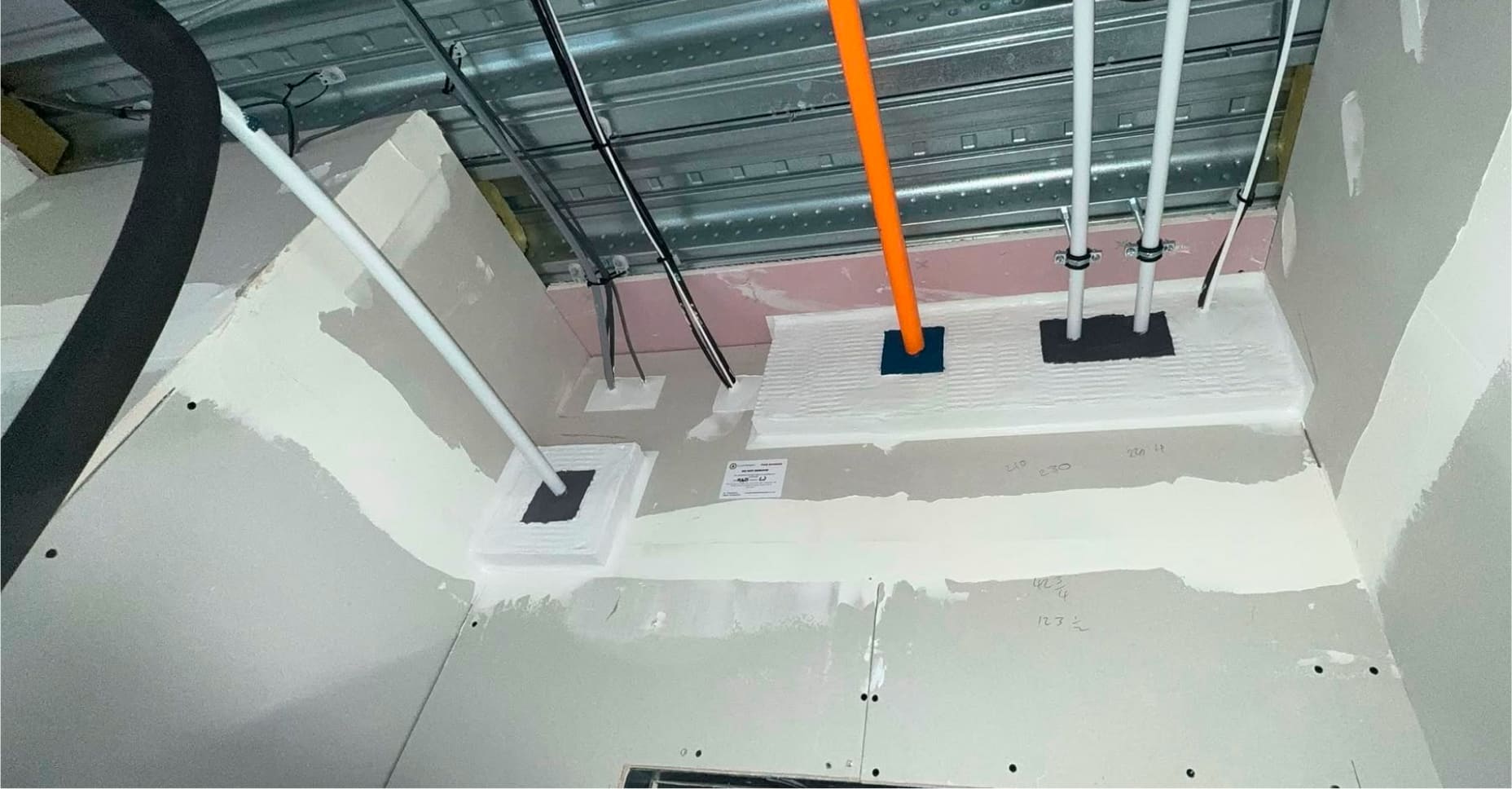
A new build can look finished — plastered, painted, ready to hand over — while the fire protection inside the walls is nowhere near compliant. Fire stopping is one of the few building elements that’s judged almost entirely on what you can’t see.
That’s exactly why it gets missed. Here’s what needs to happen, and where developers most often get stuck.
What Fire Stopping Actually Does
Every time a pipe, cable, or duct passes through a fire-rated wall or floor, it leaves a gap. Fire stopping seals that gap with tested products, so the wall keeps doing its job: holding back fire and smoke for a set period.
Miss one gap, and the whole compartment line is compromised, no matter how well everything else is built.
Where the Requirements Actually Come From
In the UK, Building Regulations set out fire safety performance standards, supported by Approved Document B and the equivalent Welsh guidance. Products and installation methods are then judged against recognised test standards, such as BS 476 and EN 1366.
For higher-risk buildings, the Building Safety Act 2022 added further scrutiny around fire safety evidence and accountability, which makes documentation more important than ever, not less.
Fire Stopping Requirements for New Builds: The Essentials
Strip away the detail, and the fire stopping requirements for new builds come down to a handful of consistent principles.
Compartmentation Must Be Maintained
Every fire-rated wall and floor is part of a compartmentation strategy. Fire stopping exists to protect that strategy at every point it’s pierced.
Every Penetration Needs a Tested Solution
A gap around a pipe or cable can’t just be filled with whatever’s on the van. The product used has to match tested evidence for that specific type and size of penetration.
Cavity Barriers Where Required
Concealed spaces — above ceilings, behind cladding, inside partition walls — often need cavity barriers to stop fire travelling unseen through the building.
Products Need Third-Party Certification
Certified products give evidence the system has actually been tested as installed, not just assumed to work because the ingredients sound right.
Installation Must Match the Test Evidence
A correctly specified product installed the wrong way can still fail. The fixing method, depth, and surrounding materials all need to match what was actually tested.
Common Mistakes on New Build Sites
- Using a generic sealant instead of a product tested for that specific penetration
- Cables added later in the programme without resealing the opening properly
- Cavity barriers missed at junctions, corners, or service risers
- No photographic or written record kept before walls are boarded over
Why These Requirements Get Missed So Often
Multiple trades often pass pipework and cabling through the same walls at different stages of the build, and fire stopping can fall between the gaps of who’s actually responsible for sealing it.
Once boarding and plastering cover everything up, checking the fire stopping requirements for new builds properly becomes far harder, and far more expensive if something has to be opened back up.
Working With a Specialist, Not Just a Subcontractor
Reliable fire stopping contractors won’t just turn up and seal gaps. They’ll document what’s been installed, where, and with what product, so there’s a clear compliance trail if it’s ever questioned.
- Ask for photographic evidence of each penetration before and after sealing
- Check products are third-party certified, not just “fire-rated” on the label
- Confirm who inspects the work before it gets covered up
Why Developers in Bridgend Choose Local Expertise
Working with fire stopping specialists Bridgend developers already know tends to mean fewer coordination issues, since local knowledge of common build types and typical site sequencing speeds up getting it right the first time.
Why Choose Integrity Firestop Systems Ltd
Integrity Firestop Systems Ltd works directly with developers and main contractors across Bridgend, documenting every penetration sealed so compliance evidence is ready whenever it’s needed.
Planning a new build? Get in touch with Integrity Firestop Systems Ltd at https://ifss.org.uk